600m²
Reservation of a space of up to 600 square meters, incorporating the entry and exit routes for waste trucks and gas vehicles
60m²
Machine and peripheral dimensions
400 Kwh
Required power. Three-phase meter
94%
Up to 94% efficiency
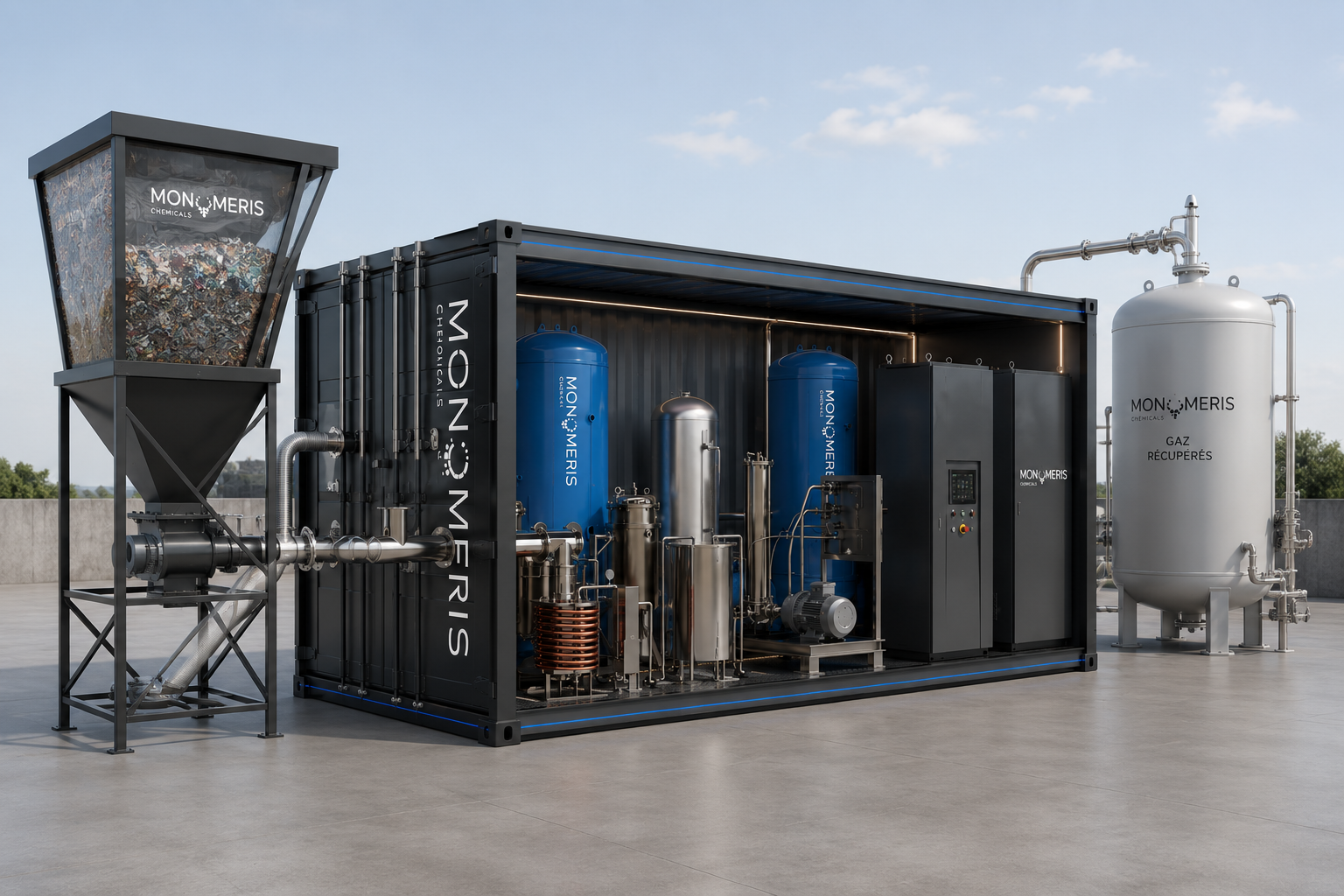
Our recycling Process
Monomeris Chemicals’ technology is designed to provide a turnkey, sustainable, and cost-effective solution for the chemical recycling of plastics. It is based on strong and flexible industrial partnerships tailored to the nature of the waste, customers’ capabilities, and their strategic objectives.
Recyclability of Plastic Waste
The problem with plastic recyclability stems from the fact that there are many types of plastics with different properties, some of which are difficult or impossible to recycle; that many products are made of multiple materials that are hard to separate; and that waste is often contaminated with food scraps...
Why use advanced recycling for these materials?
These products are made of different polymers, often assembled in layers or very small parts, and sometimes contain additives, which prevents the recovery of a homogeneous plastic material through physical processes; processing them at the molecular level allows the polymer structure to be “broken down” into basic building blocks (monomers or simple molecules) or into more uniform raw materials capable of accommodating plastic blends, flexible materials, films, and composites...
Technical Feasibility Assessment at Monomeris Chemicals
Before entering into any partnership, Monomeris Chemicals conducts a technical feasibility study to assess the recycling potential of a plastic waste stream. This step is essential to ensure the waste stream’s compatibility with our ionic recycling technology, optimize plant performance, and ensure the project’s economic viability.
As a reminder, the MELTA solution is the first technology capable of recycling all types of mixed plastic waste, which until now has been the main obstacle to increasing the recyclability rate of plastic waste.
Technical Feasibility
In order to optimize our recycling process, we need to determine the composition of the waste in our laboratory.

Processing capacity
The machine's capacity and the project's profitability depend heavily on the tonnage.

Geographical location
It affects logistics, transportation costs, machine placement, and access to utilities (water, gas, electricity).

Current Solution
Understanding the current solution allows us to better position our offering in terms of cost, environmental performance, and added value.

Treatment Cost
This allows you to compare Monomeris’s offer with the actual cost you are currently paying, and to determine the project’s cost-effectiveness.

Waste Management
This allows you to compare Monomeris’s offer with the actual costs you are currently incurring and to determine the project’s economic benefits.

Crushed waste
To ensure a stable chemical reaction, the particle size must be relatively uniform, and the waste must be crushed beforehand (maximum 25 mm).
Contamination levels
Excessive contamination compromises performance and increases pretreatment costs.
Why choose advanced recycling?
Monomeris Chemicals’ technology is designed to provide a turnkey, sustainable, and cost-effective solution for the chemical recycling of plastics. It is based on strong and flexible industrial partnerships tailored to the nature of the waste, customers’ capabilities, and their strategic objectives.
Everyday products that are difficult to recycle

01
02
03
04
05


Newsletter
Sign up for our newsletter so you don't miss any of our updates